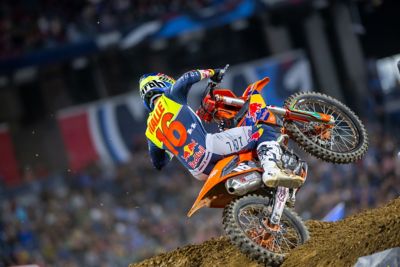
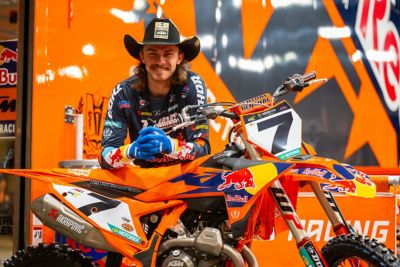
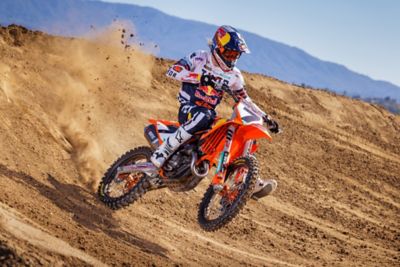
Red Bull KTM Factory Racing has re-signed fan favorite Aaron Plessinger for the 2025 SuperMotocross World Championship (SMX) season, which will continue to include the AMA Supercross and Pro Motocross Championships ahead of the SMX Finals Series.
At 28 years of age, Plessinger is currently in the prime of his premier class career, to remain equipped with the KTM 450 SX-F FACTORY EDITION into next year and to continue the rapid progression that he and the team had achieved in 450SX this season, prior to him being injured in Round 13 at Foxborough.
'The Cowboy' has been in spectacular form during 2024, holding the red plate for multiple rounds after picking up his first-career 450SX victory in San Diego, and then going on to claim additional podium finishes at the Anaheim 2 Triple Crown and in Arlington. He will unfortunately miss the final four rounds of Supercross with a fractured elbow, but is expecting to be READY TO RACE when the gates drop on the AMA Pro Motocross Championship in Pala, California, on May 25th.
Plessinger first joined Red Bull KTM Factory Racing in 2022, gaining momentum in 2023 by finishing third in the final 450MX standings and fifth position in the inaugural 450SMX Championship, prior to his breakout campaign this year.
Aaron Plessinger: "I'm really excited to be staying with Red Bull KTM through 2025. It is an awesome team and I think we're going to do some big things together in the future – even bigger and better than what we've achieved so far. I couldn't be more stoked to be staying within this family and building upon where we're at, the level that we have been able to reach this season. For this year we made some major changes in the pre-season and really haven't changed the bike at all since, which has really, really worked out in our favor. I've won my first Supercross Main Event, have gotten three podiums in total, and something's clicked for us this year. This is the most enjoyment I've had in my entire 450 career and I'm just enjoying the ride, which is rare, and I'm very fortunate. I'm stoked to be back for 2025, so hope we keep progressing and I will be doing my best to perform to the level that we aim to once I am able to line up again outdoors. I'll keep riding my heart out when I'm back from injury and am really blessed to be staying with the crew."
Ian Harrison – Red Bull KTM Factory Racing Team Manager: "We are really pleased to have Aaron back on the team for 2025 – he is an asset to our team from so many different aspects, from his personality to his riding, and his results. Since joining our team in 2021 he has continued his progression each year and this 2024 season we have had our best yet with him. Once he returns, we hope to continue this momentum and experience with the team for the rest of the year and into 2025. It is a pleasure to have him on our team and I look forward to next year with him. He's not only good for himself, but he’s good for the other riders too, as well as our team morale, mechanics, and everybody. He is a great person and a real asset to the Red Bull KTM Factory Racing Team."
Roger De Coster – Director of Motorsports, North America: "I'm really happy that we were able to extend Aaron’s contract and we are really looking forward to ending this year strong in Pro Motocross before continuing into the 2025 season with him. He is fun to work with, he is great for the team, he’s good for other riders, and he’s good for the crew. We are very happy to have him."